CLICK HERE FOR FREE BLOGGER TEMPLATES, LINK BUTTONS AND MORE! »

Latest Happenings

Hi, everyone! I have finally managed to write something. I hope 2017 will bring many great things for all of us!
-TM, 2nd February 2017

Friday, January 14, 2011

Puppet-Making Workshop

   What do you think of puppets?

Aren't they cute?
   And yes... today we had a workshop on how to make puppets. The course was organised by Jabatan Bahasa (something they've been doing for the past two or three years for B. Ed TESL students) and conducted by Encik Zainal Ariffin Abdul Ghani. 

   It was very fun! I'm afraid I missed out on quite a bit, and I also didn't have time to take any pictures, but if I do get hold of any from my friends, I'll definitely upload them here later.

   According to our coordinator, the use of puppets is something that is emphasised on in KSSR (I explained this in a previous entry). This is because in KSSR, learning is supposed to be fun, and what better way for learning to be fun than to have activities which involve a lot of creativity and acting?

   It was amazing to see how newspapers, manila cards and even a blank piece of paper could be turned into masks, puppets and little toys (with the help of staplers, celotape, etc.) I learned that for teachers, there is no such thing as saying 'no' or ;impossible'. There is so much that we can do to make pupils interested in learning! If you fail using one technique, there are hundreds more that you can try!

   Since I don't have that much to tell you about this course, I've done a short research on the internet and found some interesting sites that teaches you how to make your own puppets. Enjoy!

Wednesday, January 12, 2011

Course on KSSR

   It is high time I update this blog. I do have lots to write about, but I haven't had time to do it. Honestly, how will I manage when practicum starts next week?

   Anyway, let's get to the topic. Today I attended a course on KSSR, which stands for Kurikulum Standard Sekolah Rendah. Did you know that the curriculum for Malaysian schools is revised and updated every ten years? This is the stages that our curriculum has gone through, as far as I can remember:

   1983 - KBSR: Kurikulum Baru Sekolah Rendah
   1993 - KBSR: Kurikulum Bersepadu Sekolah Rendah
   2003 - KBSR: Kurikulum Bersepadu Sekolah Rendah (revised)
   2011 - KSSR: Kurikulum Standard Sekolah Rendah

   The course provided a lot of information on KSSR, but I shall try to be brief and explain a little bit on what it is about, focusing especially on the teaching and learning of English.

   Basically, in KSSR language skills are taught in stages, throughout the week.For example, there are 5 schooling days in a week. Therefore, language skills will be taught as follows:

   Day 1 - Listening & Speaking
   Day 2 - Reading
   Day 3 - Writing
   Day 4 - Grammar
   Day 5 - Language Arts

   In addition, each week will focus on only one theme. Therefore, if the theme for the week is on 'My Family', the teacher must plan lessons according to the skill set for the day.

    I find this system very organised and makes it easier for teachers to plan lessons. This way, the lesson can progress from one stage to another, and children do not get muddled up by too many activities in one lesson. At the same time, they may also follow the lesson at their own pace, and participate as much as they can because they only need to focus on a particular skill for one day. However, of course there will also be an integration of skills when necessary.

   One of the evident elements in KSSR is that it focuses on teaching English so that pupils may actually use it to communicate in class. This is why the skills of listening and speaking is emphasised in the first stage of the week. This is because young children are more prone to listening to sounds and responding to it, for example by repeating or mimicking what they hear. Therefore, it is important that teachers are very verbal and active during these lessons.

Listening is the most important language and yet is the least taught
Speaking skills must be taught for pupils to be able to use language to communicate
   There were many more things that we learned during the course. I might write more about it, if I remember what they are! Unfortunately, I missed most of the practical session, but from what I managed to catch is that the use of sounds, songs and nursery rhymes should greatly be emphasised on in KSSR to make learning fun.

   KSSR will start for Standard 1 (in fact, it has already started!) for Standard 1 pupils this year. However, of course the institute has advised us to take only pupils from Standard 2 to 5 for practicum.

   I'm nervous. Only a few days left before I enter the real world of teaching. School, here I come!

Wednesday, December 15, 2010

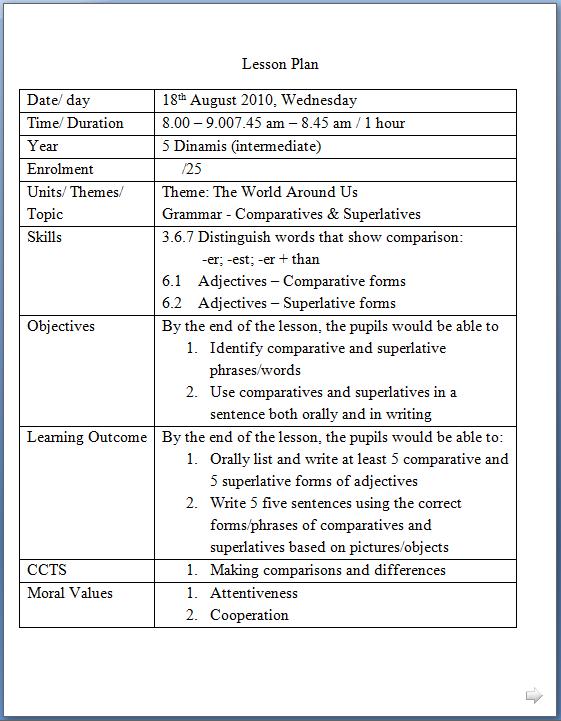
English: Grammar: Comparatives & Superlatives

   After looking at most of the lesson plans that I've done, I realise that most of them are for advanced pupils. Sigh. Well, anyway I guess the ideas are what's important. But it takes so long to edit each lesson plan. So I thought I'd try this out instead (click on each image for a larger view):


TESL = Teaching English as a Second Language

   Assalamualaikum.

   I still haven't finished reading the Hot Tips book, so nope, I don't have any new Tips for anyone.

   Last night I decided to post some lesson plans that I wrote as part of my coursework for the last three and a half years (not counting the foundation period), but it takes so long to edit each lesson plan due to the fact that all my LPs were written (or typed) using MS Word, and most of the steps were arranged in tables etc. So I have to copy and paste everything neatly and arrange them in paragraphs to be made suitable for posting on this blog... you get the idea. It's a LOT of work. I wonder how Celine did it for Mdm. Is.

   Anyway, I'll probably finish doing all that in ten years, so I thought I'd take a side leap and talk a little bit about the training programme that I'm currently in.


Source

   It's called T.E.S.L, and as the title implies it refers to the Teaching of English as a Second Language. That should be enough to tell you that people who go through this programme will come out as English teachers, but I need something to write about so I'll write anyway.
   One thing you should know is that there are different types of TESL programmes- all over Malaysia and all over the world (I actually didn't know there were TESL programmes in other countries, but I Googled and found out). There are the ones like the TESL programmes in universities like UM, UKM , UPSI, IIUM etc. and there are twinning TESL programmes like mine, which I'll talk about in a bit. My sister is a TESL graduate from UM.

   What's the difference between all the different types of programmes? Well to be honest I don't quite know myself, but maybe you'll figure it out after you've read about the programme that I am in.

   The TESL programme that I am in is actually a twinning programme between a teacher-training institution (or Institut Pendidikan Guru, IPG for short) and an established university in Malaysia. IPG used to be known as maktabs, but they have since been upgraded to institutions, in that they're allowed to now grant B. Ed certs to their students, instead of just a Diploma.

   I guess the reason why we have the twinning programme is because the college could not grant degrees to TESL students, so they do it by having this twinning programme. There are several cycles for the programme, I think, and I am in the fourth cohort or badge in my cycle. I only really know a little about my cycle, so I'll talk about that.

   There are nine IPGs which have the TESL Twinning Programme students. I know of this thanks to a TESL camp that I went to a few years back. The IPGs and universities involve are:

1. IPG Kampus Perempuan Melayu + International Islamic University Malaysia
2. IPPPP (Penang) + UUM
3. IPTI + UPM
4. IPG Ilmu Khas + UM
5. IPSAH + UPSI
6. IPG Gaya (Sabah) + UITM Shah Alam
7. IPG Batu Lintang (Sarawak) + (UNIMAS, I think)
8. IPG Kota Bharu + UITM Shah Alam
9. IPBA + overseas universities

   I might have made some mistakes up there, so if anyone reading this needs to correct me, by all means do so.

   The application for the programme is made right after SPM, using our SPM results. During my cohort we had to do it using the UPU form, in which we also apply for choices in other university courses, but I think the 5th cohort did the application through the IPG form.

   After you've been accepted into the programme, you'll go through two years of foundation studies, which is basically when they make sure your language skills are up to standard, enough and if possible more than enough to qualify you to be able to teach English. The subjects we learned were:

1. Language Description (all grammar and stuff which I liked)
2. Language Development (mostly to do with writing essays, comprehension etc. which I also like)
3. English Studies (literature, which I absolutely like!)
4. Social Studies (what the name implies, and is probably intended to help with our general knowledge, which I like but never really scored until the last minute)
5. Numerical Literacy (Mathematics, which we took for two terms out of four)
6. Islamic Studies (which we took for the other two terms)

   I think the last two differed according to different IPGs, since both weren't really core subjects. We only had two exams for the whole of two years- a mock one, after we completed our first year of studies, and the final exam, taken after we completed the whole foundation.

   Having completed the foundation course, we would then enter our degree programme. In the case of my friends and I who studied at IPG KPM, we journeyed to IIUM for an Induction Week or better known as the Ta'aruf Week so that we could get to know about the university. It was okay I guess, but a bit boring because most of the briefings didn't really concern us.

   Then we went back to the institute to continue our first year studies. Yup. After that, we went back to IIUM for our second and third year, and we came back to our institute in Malacca for our final year. Phew! 

   I'm not sure if the same process goes for our friends from the other IPGs, but I do know that the Ilmu Khas people, whose institute twinned with UM, only went to UM for their third and fourth year.

   That's about it about our programme, and I'm sure there are different TESL programmes out there that I don't know about. Just for your interest, I found these other TESL programmes in other countries. Check them out.

Source

Source
   
   And so... here I am, about to enter my final semester. In which I will be doing practicum. Gulp. That's only about a month away! I'll probably have plenty to talk about then, but I wonder if I'll have time to do it. I hope I do.

   If anyone reading this is interested in doing the TESL programme, then by all means go for it! If you have a good command of the language, a sufficient amount of interest in teaching and in kids, then find out what you can and go for it!

   Let's help introduce the English Language as a fun and interesting language for kids to learn. 

   The End.

   (boring entry huh? I'll find some pics to spice it up a bit later. I notice that people don't usually write that much in their blogs, but they do put up a LOT of pictures to make their entries interesting. Oh, well.)

Friday, December 10, 2010

Hot Tips for Teachers: The Learning Line

   A few weeks ago, Dad came home and plopped this book down in front of me:


   "Hot Tips for Teachers".

   Cool. Well, it's just as well. Rather than lazing around at at home and doing... well, nothing, I might as well read a book or two that can help me become a good teacher, because that is what I am going to be. A teacher.

   Anyway, so far I have only finished the last chapter. It's a good book, I guess, just a little not-my-type in its presentation style. You have to go through this process of looking at your own teaching process in the classroom (which I am yet to do) and write down what happens after you use a particular technique.

   It's a little boring, but of course I shouldn't be saying that. Besides, the authors must know what they're talking, enough to get their book published (something I'll never achieve, huhu), so I'm going to give them the benefit of the doubt and keep on reading.

   There is one particular technique that I am interested in. It's in Part 1, which lists down Hot Tips for Opening the Lesson. It's called "Draw the Learning Line". In this activity, the teacher will draw a line at the door using a piece of chalk, adhesive tape or anything that works, and write "The Learning Line" on it. This is supposed to help students get into the mood of the lesson and prepare for learning.

   Students and teacher will then enter the class by stepping over the learning line, one by one. As soon as they enter the class, voila! They're in Learning Land! Well at least that's what I call it.

   Anyway, this Hot Tip gave me an idea for a nice way of injecting interest into students (ouch that sounds painful, maybe I should have chosen a better word...but anyway).

   Let's say the topic for my English Lesson for the Day is something that has to do with animals. Animals leads you to zoo. And so, instead of using the Learning Line (or using it anyway, only with a different name), I can use the "Going to the Zoo" Line. I can either draw a line using chalk, paper or adhesive tape as mentioned above, and write "Zoo" on it. Then students will step over the line from outside the classroom door and pretend they're entering the zoo! What do you think?

   If you're up for more work, you could make an arch out of cardboard or other materials and hang it on the doorway. The idea is the same- to get the students into the mood of the lesson, and to let them take a guess at the topic for the day.

   I can't wait to try this out! :)