CLICK HERE FOR FREE BLOGGER TEMPLATES, LINK BUTTONS AND MORE! »

Latest Happenings

Hi, everyone! I have finally managed to write something. I hope 2017 will bring many great things for all of us!
-TM, 2nd February 2017

Monday, January 17, 2011

My First Day At School... Was a Lot Better Than My First Day of SBE!

   And so... my first day of teaching practice Sekolah Kebangsaan Pegoh ended. Just like that.

   No. Not just like that. I've so much to do, and in such little time. My head is spinning, and I feel like throwing up, not to mention feeling nervous (something that won;t go away for some time, I'm sure). I think all teacher trainees go through it. I suppose it's normal.

   Today, my partner and I actually planned to go to school early, but we didn't expect the traffic to be quite so busy as it was. We arrived at 7.20 am, which was quite late for this school as they have daily programmes that start at 7 everyday. Yes. You read right. If I'm not mistaken, most of my friends' schools are also like that.

   As soon as we arrived, we met the Senior Assistant Teacher (or GPK 1 which stand for Guru Penolong Kanan 1), who talked to us for a while and promised to give us a short briefing after the assembly ended. Coincidentally, our first day at school was the opening ceremony for the NILAM programme at SKP. We received a small brochure for the programme (yay! One document for our portfolio) and exchanged brief greetings with some of the teachers.

   It was a relief to have my partner around. I can still remember how awful, lonely, miserable and out of place I felt during the first days of my SBE last year! This time, it was nice to have someone I know to talk to and share jokes and laughs from time to time. At least one doesn't feel so awkward to be 'the new guy'.

   I won't describe the NILAM ceremony, but it was quite simple. The pupils sat on chairs during the assembly. Not surprising of course- there are only 73 of them! They were quite some of the most well-behaved children I've seen so far, probably because there are so few of them and discipline is easier to handle.

   After the ceremony ended, we had our briefing with the GPK 1, who was very nice and straightforward. He helped lessen the anxiety that we had by assuring us that a small school would help to give us better control of the class, better attention from children and more.

   He assigned us to our respective classes.( Ahhhhh!!!!) I was assigned to teach English for Year 3 and Art for Year 2 and Year 3, while my partner was assigned to Year 4 English and Art for Year 4 and 5. The GPK 1 thought that it would be easier to assign one person for Level 1 pupils (Standard 1 to 3) and the other for Level 2 pupils (Year 4 to 6) as it would help to make us familiar with our pupils.

   Initially, our minor subject was Local Studies, but the GPK said that since there is only 1 class for each level, we would only have 9 or 10 hours per week each. So he requested that we change to Arts, as we could take four classes, which means that I would take 2 classes (four hours) and my partner would take another two (also four hours). This meant that I would have 12 hours since there are 8 hours for Level 1 English while my partner would have 7 hours as that is the allocated time for Level 2 English.

   We spent the rest of the day meeting our 'guru pembimbing' and the teachers from whom we would be taking over classes. We found out what topics they had already taught, and where we should pick up. We also looked at (and borrowed!) the yearly planner so that we could look at the topics and skills we would be teaching.

   In the afternoon, we had co-curricular activities for uniformed bodies and some games. Since there are so few pupils, the school only has a uniformed body- Scouts.

   Well, that's it for today. I'm afraid it's all rather dry and straightforward, as there are no pictures. I haven't had much time to take any, and my camera phone doesn't produce very good photos. I have plans to buy a camera, but that will have to wait!

   Tomorrow my partner and I have to enter relief classes! I wonder how we'll manage...

   Special thanks to my partner for being my partner! Haha. Insya-Allah things will be easier when one has a friend to talk to :D Let's help each other, ne! Ganbatte!

Sunday, January 16, 2011

CCTS & Study Skills for Lesson Planning

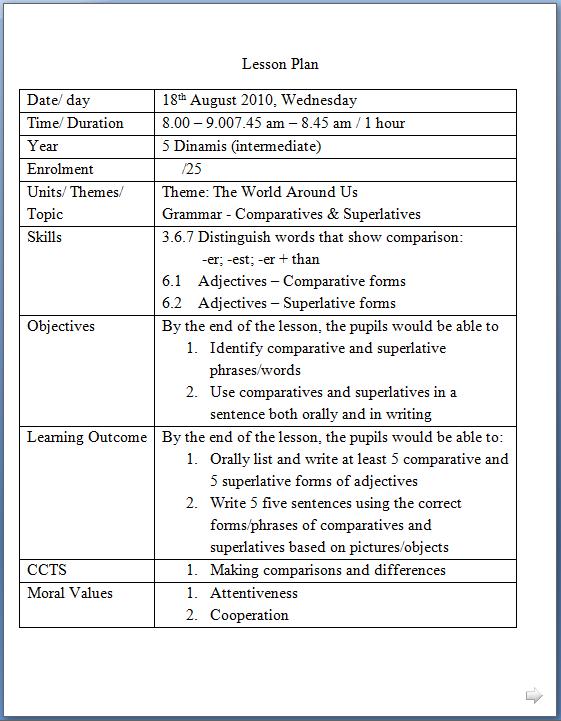
   So far all the lesson plans that I've done require teachers to state the critical & creative thinking skills that will be implemented in the lesson.

   Below is a list of CCTS I got from my lecturer, as well as a list of study skills. I will edit and update if there are additions and changes. You may need to see where the skill are mentioned so you can read this entry to find out (click on the first picture). However there's no mention of study skills so if I post a lesson plan that has some, I'll put a link later.

Critical Thinking Skills
1.  Identifying characteristics
2.  Comparing and contrasting
3.  Grouping and categorising
4.  Sequencing
5.  Arranging in order of priority
6.  Analysing
7.  Identifying facts and opinions
8.  Evaluating
9.  Enhancing conclusions
10. Identifying causes and effects


Creative Thinking Skills
1.  Generating ideas
2.  Making associations
3.  Making inferences
4.  Making predictions
5.  Making hypotheses
6.  Synthesising (making generalisations)
7.  Creating mental pictures
8.  Drawing mental pictures
9.  Drawing analogies
10.  Creating metaphors


Study Skills
1.  Collecting & classifying information
2.  Translating information
3.  Analysing
4.  Synthesising
5.  Application

   I think there are different versions for this, but as I said I will update later when I find more. You can get the Bahasa Melayu version here.

   More to come in the days to come! Insya-Allah :)

Saturday, January 15, 2011

List of Moral Values for Lesson Planning

   These few days have been a blur... because things are happening so fast!

   I have lots to blog about, but because I'm short of time, I'll just post this list of moral values. It's useful for teachers and trainees alike in planning lessons as in every lesson plan, you must always include at least one moral value to accompany your lesson content! This is from the ministry, there's a short introduction to it, but I don't have it now- will post when I find it!

   Please understand that I am not plagiarising or anything! Hehe. Nor am I posting this just for the mere sake of posting. I just think this would be good for future teachers to know.

MORAL VALUES IN THE ISSC

Background
   A Moral Education Committee (Jawatankuasa Pendidikan Akhlak) was formed in 1976 comprising prominent members respecting various religions in the country. This committee deliberated on moral values inherent in each religion and finally identified 16 universal moral values supported by all. In the ISSC, these 16 umbrella values have been expanded to 80 values.


1. KINDHEARTEDNESS
    1.1  Compassionate
    1.2  Considerate
    1.3  Generous
    1.4  Understanding
    1.5  Forgiving

2. SELF-RELIANCE
    2.1  Responsible
    2.2  Independent
    2.3  Industrious
    2.4  Self-confident

3. HUMILITY
    3.1  Polite
    3.2  Admitting one's mistake
    3.3  Friendly

4. MUTUAL RESPECT
    4.1  Respect and loyal towards parents
    4.2  Respect for the elderly, teachers, peers, leaders and neighbours
    4.3  Respect for king and country
    4.4  Respect for basic rights
    4.5  Respect for beliefs and cultures of various races
    4.6  Respect for individual rights
    4.7  Adherence to the rule of law
    4.8  Adherence to time (punctual)
    4.9  Value wisdom, experience and deeds
    4.10  Value manual labour
    4.11  Value self-respect

5. LOVE
    5.1  Love for life
    5.2  Love for the environment
    5.3  Love for the country
    5.4  Love for peace and harmony

6. JUSTICE
    6.1  Just
    6.2  Fair

7. FREEDOM
    7.1  Freedom within the law
    7.2  Freedom within the democratic system

8. COURAGE
    8.1  Brave
    8.2  Stand up to the truth
    8.3  Resolute
    8.4  Responsible/Accountable

9. CLEANLINESS OF BODY AND MIND
    9.1  Physical cleanliness
    9.2  Environmental cleanliness
    9.3  Well-mannered in words and actions
    9.4  Healthy and constructive thoughts

10. HONESTY/INTEGRITY
    10.1  Trustworthy
    10.2  Speaking the truth
    10.3  Sincere

11. DILIGENCE
    11.1  Courageous
    11.2  Pro-active/Resourceful
    11.3  Dedicated to work
    11.4  Determined
    11.5  Hardworking

12. COOPERATION
    12.1  Spirit of brotherhood
    12.2  Collective responsibility
    12.3  Helping one another
    12.4  Tolerance
    12.5  Common good
    12.6  Unity

13. MODERATION
    13.1  Moderation in reconciling personal needs with... (this part is missing, will update)
    13.2  Not excessive in words and actions

14. GRATITUDE
    14.1  Thankful
    14.2  Grateful
    14.3  Appreciative

15. RATIONALITY
    15.1  Able to form judgements
    15.2  Able to reason
    15.3  Open minded and able to think logically

16. PUBLIC SPIRITEDNESS
    16.1  Subscribing to consensus
    16.2  Subscribing to the spirit of neighbourliness
    16.3  Sensitive to social issues in the community

[Translated from the Malay version by:
Haji Abdul Aziz Sultan
Zainurin Abdul Rahman
Tunku Badariah Tunku Ahmad]

   I hope this is useful and helps you especially if you're a teacher trainee! When I wrote lesson plans as part of my assignments, I was also scratching my head because I didn't have a list of moral values (which is an essential element in all lesson plans- you can look at the example I've provided), until one of my lecturers gave us a list when we were in IIUM. Thank you, Dr. Ismail! Unfortunately I lost it... bla bla bla, long story, but since I couldn't find it on the internet either when I looked, here it is! Hope it helps you.

   All the best to my TESL friends who are heading for practicum... you are all CEMERLANG candidates! Insya-Allah :)
You are all going to be excellent teachers!!!
p.s. Special thanks to my friend Ikha for posting the list of FB! Thanks a million :P

Friday, January 14, 2011

Puppet-Making Workshop

   What do you think of puppets?

Aren't they cute?
   And yes... today we had a workshop on how to make puppets. The course was organised by Jabatan Bahasa (something they've been doing for the past two or three years for B. Ed TESL students) and conducted by Encik Zainal Ariffin Abdul Ghani. 

   It was very fun! I'm afraid I missed out on quite a bit, and I also didn't have time to take any pictures, but if I do get hold of any from my friends, I'll definitely upload them here later.

   According to our coordinator, the use of puppets is something that is emphasised on in KSSR (I explained this in a previous entry). This is because in KSSR, learning is supposed to be fun, and what better way for learning to be fun than to have activities which involve a lot of creativity and acting?

   It was amazing to see how newspapers, manila cards and even a blank piece of paper could be turned into masks, puppets and little toys (with the help of staplers, celotape, etc.) I learned that for teachers, there is no such thing as saying 'no' or ;impossible'. There is so much that we can do to make pupils interested in learning! If you fail using one technique, there are hundreds more that you can try!

   Since I don't have that much to tell you about this course, I've done a short research on the internet and found some interesting sites that teaches you how to make your own puppets. Enjoy!

Wednesday, January 12, 2011

Course on KSSR

   It is high time I update this blog. I do have lots to write about, but I haven't had time to do it. Honestly, how will I manage when practicum starts next week?

   Anyway, let's get to the topic. Today I attended a course on KSSR, which stands for Kurikulum Standard Sekolah Rendah. Did you know that the curriculum for Malaysian schools is revised and updated every ten years? This is the stages that our curriculum has gone through, as far as I can remember:

   1983 - KBSR: Kurikulum Baru Sekolah Rendah
   1993 - KBSR: Kurikulum Bersepadu Sekolah Rendah
   2003 - KBSR: Kurikulum Bersepadu Sekolah Rendah (revised)
   2011 - KSSR: Kurikulum Standard Sekolah Rendah

   The course provided a lot of information on KSSR, but I shall try to be brief and explain a little bit on what it is about, focusing especially on the teaching and learning of English.

   Basically, in KSSR language skills are taught in stages, throughout the week.For example, there are 5 schooling days in a week. Therefore, language skills will be taught as follows:

   Day 1 - Listening & Speaking
   Day 2 - Reading
   Day 3 - Writing
   Day 4 - Grammar
   Day 5 - Language Arts

   In addition, each week will focus on only one theme. Therefore, if the theme for the week is on 'My Family', the teacher must plan lessons according to the skill set for the day.

    I find this system very organised and makes it easier for teachers to plan lessons. This way, the lesson can progress from one stage to another, and children do not get muddled up by too many activities in one lesson. At the same time, they may also follow the lesson at their own pace, and participate as much as they can because they only need to focus on a particular skill for one day. However, of course there will also be an integration of skills when necessary.

   One of the evident elements in KSSR is that it focuses on teaching English so that pupils may actually use it to communicate in class. This is why the skills of listening and speaking is emphasised in the first stage of the week. This is because young children are more prone to listening to sounds and responding to it, for example by repeating or mimicking what they hear. Therefore, it is important that teachers are very verbal and active during these lessons.

Listening is the most important language and yet is the least taught
Speaking skills must be taught for pupils to be able to use language to communicate
   There were many more things that we learned during the course. I might write more about it, if I remember what they are! Unfortunately, I missed most of the practical session, but from what I managed to catch is that the use of sounds, songs and nursery rhymes should greatly be emphasised on in KSSR to make learning fun.

   KSSR will start for Standard 1 (in fact, it has already started!) for Standard 1 pupils this year. However, of course the institute has advised us to take only pupils from Standard 2 to 5 for practicum.

   I'm nervous. Only a few days left before I enter the real world of teaching. School, here I come!